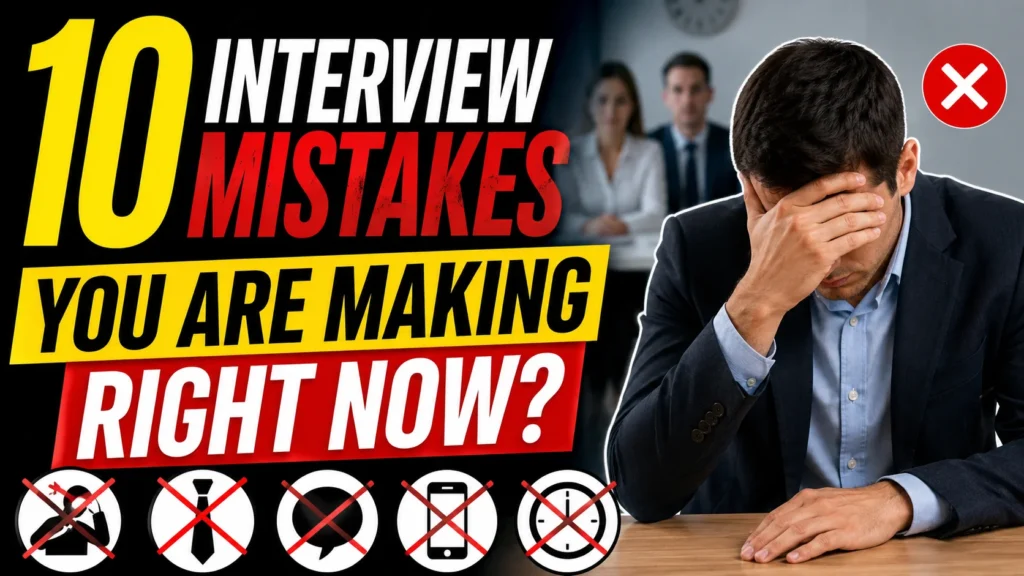
Your Job Interview Could Be The Biggest Road Block In Your Way. You’ve got all the right credentials, you’ve got the experience and the skills but a few careless slipups in your job interview can ruin it all. You might be committing these mistakes subconsciously which could reflect badly on you in front of the interviewer before you even answer the first question.
Regardless of you being a first time job hunter or a professional looking for your next job opportunity, being aware of these 10 Interview Mistakes You Are Making Right Now will go a long way to increasing your job prospects.
The Pakistani job market is very competitive and employers often get hundreds of applications per vacancy, hence employers feel it important to take efficient decisions in a short period.
Why Interview Performance Matters
Not only do recruiters scrutinize your qualifications, but they also look for your:
- Communication skills
- Professional conduct
- Confident behaviour or attitude
- Problem-solving skills
- Body language
- Time management
- Cultural fit.
In many cases, a great interview can balance out your lack of experience; in the opposite direction, a great interview cannot overcome a bad experience.
10 Interview Mistakes You Are Making Right Now
| Mistake | Impact | Easy Solution |
|---|---|---|
| Arriving Late | Creates poor first impression | Reach 20 minutes early |
| No Company Research | Shows lack of interest | Study company website |
| Weak Body Language | Appears nervous | Maintain eye contact |
| Talking Too Much | Confuses interviewer | Keep answers concise |
| Poor Dress Code | Looks unprofessional | Wear formal attire |
| No Questions Asked | Appears uninterested | Prepare 3–5 questions |
| Negative Comments | Raises concerns | Stay positive |
| Phone Interruptions | Looks disrespectful | Turn phone off |
| Memorized Answers | Sounds robotic | Speak naturally |
| No Follow-Up | Missed opportunity | Send thank-you email |
Arriving Late
Being late is one of the quickest ways to create a negative impression. Even if your qualifications are excellent, arriving late signals poor planning and lack of professionalism.
How to Avoid It
- Leave home earlier than planned.
- Check traffic conditions.
- Keep interview documents ready.
- Reach 15–20 minutes early.
Not Researching the Company
So much preparation goes into the responses, yet so few candidates seem to prepare much at all when it comes to the employer.
Some classic interview questions to watch out for are:
- What do you know about our company?
- What makes you want to join us?
You’d be surprised how many candidates can’t provide convincing answers.
Research Before Interview
Learn about:
- Company history
- Products and services
- CEO
- Company culture
- Recent news
- Competitors
Wearing the Wrong Outfit
Your appearance communicates professionalism before you even speak.
Interview Dress Tips
For Men
- Ironed dress shirt
- Dress pants
- Formal shoes
- Neatly groomed hair
For Women
- Professional suit or modest formal dress
- Closed shoes
- Minimal accessories
- Light makeup
Poor Body Language
Your body language often speaks louder than your words.
Common mistakes include:
- Avoiding eye contact
- Slouching
- Crossing arms
- Constant fidgeting
- Weak handshake
Improve Body Language
- Sit upright.
- Smile naturally.
- Make eye contact.
- Use controlled hand gestures.
- Show confidence.
Talking Too Much
Some candidates answer every question with a five-minute story.
Interviewers prefer clear, structured answers.
Also Check: How to Write a Professional Resume with No Experience?
Use the STAR Method
- Situation
- Task
- Action
- Result
This keeps answers focused and professional.
Speaking Negatively About Previous Employers
Never criticize:
- Former boss
- Colleagues
- Company
- Salary
Interviewers may assume you’ll behave the same way in their organization.
Better Alternative
Instead of saying:
My manager was terrible.
Say:
I wanted better opportunities for growth and professional development.
Not Asking Questions
When the interviewer asks,
Do you have any questions?
Many candidates simply reply:
No.
This is a mistake because it signals a lack of interest.
Smart Questions to Ask
- What does success look like in this role?
- What kind of training is available?
- How is success measured?
- What are the team’s primary goals?
- What happens next?
Giving Memorized Answers
These recruiters are used to script questions. Candidates, don’t use script, this makes you sound like a robot instead of yourself.
Practice Naturally
Instead of word-for-word memorisation:
- Try to recall the main ideas, and tell your own stories
- Speaking conversationally
- Use some of your own experience authenticity creates credibility.
Ignoring Soft Skills
Technical knowledge is important, but employers also value:
- Communication
- Leadership
- Adaptability
- Teamwork
- Emotional intelligence
Show Soft Skills Through Examples
Instead of listing skills, describe real situations where you demonstrated them.
Forgetting to Follow Up
The interview is over after leaving their offices. Wrong! This will ensure you aren’t soon to be forgotten by a potential employers.
Send a Thank-You Email
Within 24 hours:
- Thank the interviewer.
- Mention something discussed.
- Reaffirm your interest.
- Keep it brief.
Mistake vs Best Practice
| Interview Mistake | Best Practice |
|---|---|
| Late Arrival | Reach 20 minutes early |
| Poor Research | Learn about company and role |
| Casual Dressing | Wear professional attire |
| Weak Body Language | Maintain confident posture |
| Long Answers | Keep responses structured |
| Negative Attitude | Stay positive |
| No Questions | Ask thoughtful questions |
| Phone On | Switch it off completely |
| Scripted Responses | Speak naturally |
| No Thank-You Email | Send follow-up within 24 hours |
Bonus Tips for Interview Success
Prepare Common Interview Questions
Sample Answers To:
- Tell me about yourself?
- How can you contribute to our organization?
- What are you doing to improve your skills?
- Where do you see yourself in five years?
Carry Necessary Documents
Bring:
- Updated Resume
- CNIC
- Educational certificates
- Experience letters
- passport photographs
- Portfolio
Practice Mock Interviews
Practice for your interview with a mentor friend or colleague. You may record yourself and watch the playback to evaluate the parts you need to improve on.
Improve Communication Skills
Talk with confidence and use clear words. Refrain from using filler Words such as:
- Umm
- Actually
- Basically
- You know
Stay Calm Under Pressure
Difficult Questions: The Interviewer may put a lot of pressure on you to probe into how your brain actually functions. Do not panic. Slow down before you start to explain.
Interview Tips for Pakistani Job Seekers
Things to Keep In Mind for Job Applications In Pakistan:
- Reach the interview on time. Many big cities like Karachi, Lahore are famous for their high traffic so try to avoid reaching late especially in these areas.
- Carry hard copies of your resume as well as soft copies in a pen drive.
- Be polite to the interviewer and greet them properly.
- If you are going to apply in any corporate or banking sector or any government firm, then it is recommended to have decent dressing.
- Be clear and confident in stating your educational background, internships, and your aspirations for your career.
- For multinational firms, you may need to prepare some answers in English although there are very few chances that you might be asked to continue the interview in Urdu, but keep it in mind.
Frequent Q&A (FAQS)
What is the largest error to be made from Candidates throughout the interview?
In my experience, candidates often make their mistake, unprepared for an interview. The company anticipates that you’ll know their company’s mission and values, products they sell and the duties and requirements of the role.
How early should I arrive for a job interview?
It’s typically recommended to show up fifteen to twenty minutes before your scheduled job interview so you don’t feel rush, and you won’t seem too eager to jump into the job interview.
Is it okay to say that I don’t know something in a job interview?
Although you may be unaware or inexperienced at performing a specific task, you may describe to your interview what steps you would take to determine information or solve problems. An example would be stating, “I am not confident at performing the task at the moment, but I will contact the [appropriate resource or person] to inquire further in order to locate my required information. I can, however, attempt to [task you know how to do].”
Should I follow up with a thank you note after a job interview?
Respond to the interviewer with a thank you note within 24 hours to reemphasize your interest in the position and express your worth to the organization. This demonstrates that you have a pleasant persona.
What should I do if I am feeling anxious or nervous before an interview?
Role play common questions so you can convey your interview answers in an authentic manner. Engage in mock job interviews to build your comfort level when you are in an interview environment and use confident body language.
Final Thoughts
Lucky for you, you can easily stop making the 10 Interview Mistakes You Are Making Right Now. In truth, an interview is so much more than a sequence of responses, and rather is about demonstrating the strongest version of yourself, the most polished, the most confident, the one most eager to jump in and get to work and to learn it all. The trick is actually preparedness answer tailored to the individual job, a good wardrobe selection, the correct non-verbal body language, and the right post-interview thank you.