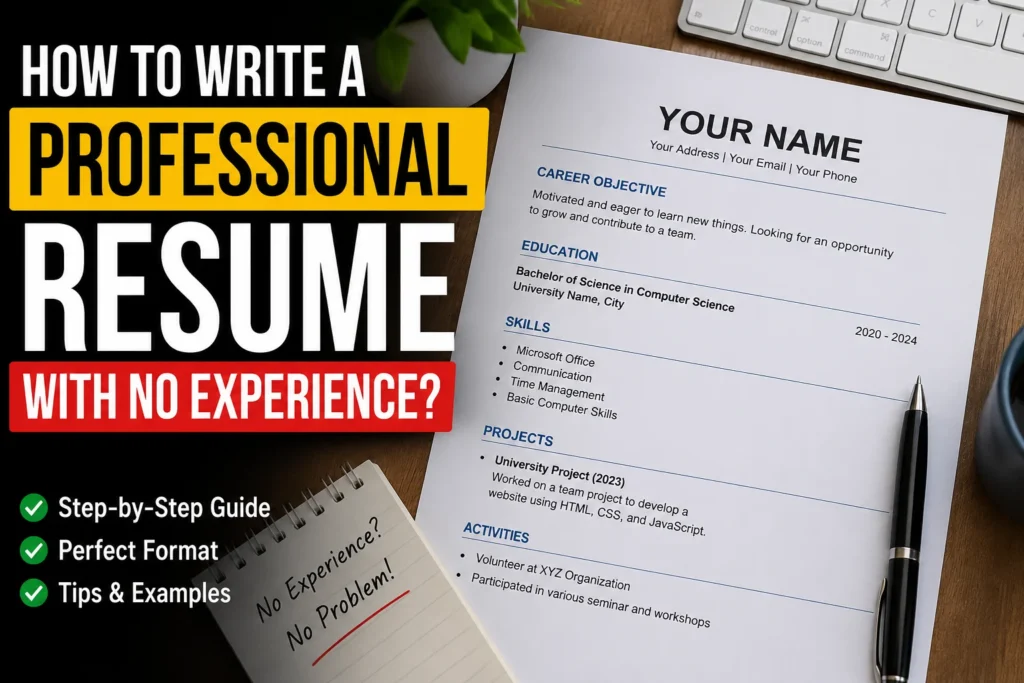
Learn How to Write a Professional Resume with No Experience in an easy way. When you enter the job market for the first time, you might think, well what is the point of that. Because all the jobs advertised have the words “3-5 years of experience” but, you cannot have this experience without someone being able to give you your opportunity! It is probably the biggest and the most painful challenge that new grads face, individuals trying to transition careers, and even students trying to get their foot in the door of their dream company with an internship.
Good news, that the job search is slowly evolving in terms of what recruiters are focusing on, in the next 5 years i.e. 2026 the hiring trends show that they are far more focused on what you can do and learn versus what the job titles you’ve already achieved were.
You do not need to have a work title to build an impressive resume what you need is a strategy. What makes a great resume without “real” work experience, is that you are able to leverage your transferred skills, past accomplishments in academics, volunteer experience and even your personal projects.
Choose the Right Resume Format
First and foremost you need to know what you want to work as before you even hit that keyboard! If you pick the wrong format, you’re making it obvious you have no experience. The correct format can be the highlight of your potential. The Functional Resume or Combination Resume will get a better review then the Chronological Resume if you have no experience.
The Functional Resume
Focuses on what you’ve accomplished, not what your employment record was. Skills ordered into categories, e.g., Project Management, Customer Service. Best for: Career changers and the unemployed (or nearly unemployed).
Pros: Emphasizes what you’re good at, not just where you were working when you were good at it.
Cons: Recruiters might be skeptical when you completely omit your dates.
The Combination Resume
This is the ideal approach to make the most of both worlds. Begin with a skills summary and also include your “Experience” (can be an internship, academic project or volunteering experience) as well as finally list your education details. Best for: Fresh Graduates and also Students Pros: Focus on skills, while at the very same time give a background on the progression of education/internship/projects.
Cons: This needs extremely careful structuring to avoid looking cluttered. I would recommend this strategy as the most efficient manner to composing a specialist resume without experience.
Also Check: What to Wear to a Professional Job Interview in Pakistan?
Start with a Strong “Professional Summary”
The “Objective” statement is dead. We are in the era of the “Professional Summary.”
A summary is a 3-4 sentence paragraph that sits at the top of your resume. This is your elevator pitch. Since you don’t have experience to list, your summary must tell the recruiter why you are a great fit based on your personality and goals.
How to Write a Summary with No Experience
Use this template:
Your Identity: Who are you? (eg “Detail-oriented recent Marketing graduate…”)
Your Skills: What hard skills and soft skills do you possess? (eg “…proficient in data analytics and social media management…”)
Your Goal: what do you want to achieve for them? (eg “…seeking to leverage analytical skills to drive customer engagement at XYZ Corp.”)
An example, as a Graphic Designer:
Creative, resourceful, and imaginative Graphic Design graduate seeking an opportunity to express a flair for narrative through compelling visuals. Skilled in the use of the Adobe Creative Suite with particular focus on Photoshop and Illustrator. Equipped with an impressive portfolio comprised of various freelance assignments and several university design competitions. Prepared to apply typography and brand creation talents to assist the creative team at DesignStudio Inc.
Pro Tip: When you’re looking at writing about yourself, never write “I am looking for an opportunity to learn.” Companies aren’t hiring you to learn! They’re hiring you to do.
Highlight Your Education (The Core of Your Resume)
Because you have no work experience, your education will serve as the core of your resume. The Education section should be at the top of the page, just below your summary.
What goes in the Education section
Degree and major: B.S. In Computer Science, Name and location of university: University of Texas, Austin
- Date of graduation: Month and year (May 2026)
- GPA: Include if above 3.5, otherwise, no GPA.
“Relevant coursework hack”.
You’ll have no work experience, so leverage any relevant courses as “experience.”
Make sure to add “Honors and awards.”
You will need to list any academic awards you’ve earned to prove that you can and will work hard. Dean’s List, Cum Laude and scholarships are all worthy of this spot.
The “Skills” Section: Your Secret Weapon
This is by far the most important section of your resume if you lack professional experience. You’re not selling titles; you are selling yourself.
Differentiating Hard Skills and Soft Skills
- Hard skills are teachable and are skills that you use to do specific tasks. (i.e. Coding, Excel, SEO, foreign languages, data analysis)
- Soft skills are personal and personality traits that relate to working with others. (i.e. Leadership, communication, problem-solving, teamwork)
How to Source Skills for Your Resume
- if the company is seeking “social media management” and “team collaboration” then make sure to include those specific keywords on your resume’s skills section. You may find skills in your personal life – were you managing a server for an online game? This means you likely engaged in troubleshooting and conflict resolution, for example. Managing family expenses would translate into strong financial management skills.
Example of a Skills Section:
| Hard Skills | Soft Skills |
|---|---|
| Microsoft Excel | Public Speaking |
| Google Analytics | Time Management |
| Python | Adaptability |
| Spanish | Problem Solving |
“Experience” Beyond a Job
Just because you’ve never been paid doesn’t mean you have no experience. Here is how to write a professional resume with no experience by expanding your definition of “work.”
Internships and Volunteering
If you interned with a company or volunteered for a non-profit, treat the experience like an actual job by following the same structure:
Title, Company Name, Dates and bullet points. Example volunteer experience: Social Media coordinator:
- (Volunteer) | The Big Food Bank | January 2025-May 2025
- Managed the social media account, which resulted in 20% more weekly engagement
- Developed weekly Twitter and Facebook content calendars to promote charity events
- Partnered with the donation team to launch an online fundraising campaign.
Academic and Personal Projects
Don’t have an official internship? Leverage Your University Projects.
Inventory Management System Project | University of XYZ | Fall 2025
Engineered and developed a SQL database to manage retail inventory for a simulated business.
Documented and generated workflow for system.
Pitched the project to an industry board, earned an “A.”
Extracurricular Activities
President of a club or being a player in a sports team are good concrete examples.
President, Business Club | University of XYZ
Led team of 15 to execute a regional networking event. Oversaw budget of $5,000 and delivered the event under budget.
Formatting and Design Tips for 2026
Most likely, a recruiter will spend 7 seconds reading your resume, tossing it if it is messy and has outdated formatting. You want a crisp, up-to-date look. Use a Clean Layout
Use a Clean Layout
- Fonts Use one of the following modern sans-serif fonts. Body of your resume, size 11 or 12 (Name: 14-16).
- Marigins Aim for 0.5- to 1-inch margins. Any thinner and your resume will appear too crowded. Any wider, and it’ll appear sparse.
- White Space Don’t stuff your text onto the page. Use white space to help direct a reader’s attention.
File Name and Submission
- File Type: Use PDF files only. If you use a different format, it might not come up in the same format when it is read on a different computer.
- File Name: Use your full name. BAD: resume.pdf. GOOD: JaneDoeResume_2026.pdf
The ATS Factor (Applicant Tracking Systems)
Many large companies use robot scanning software to go through your resume before a human gets their hands on it.
- Keyword Search: Look for keywords from the job posting and plug those exact words in. “Project Management,” for example, rather than “Managed Projects.”
- No Graphics: You want your resume as easy to read as possible for a bot, so no charts, tables, columns, icons, etc. Just text.
Proofreading and Getting a Second Opinion
What kills a resume more quickly than a typo. It can tell the employer you have poor proofreading skills.
Have a Peer Review Your Resume
This is no-brainier: If you don’t already have a good grammar checker, get one. Grammarly, the premier grammar tool, checks your resume for not only for typos, but punctuation, clarity, and tone. Another useful tool is the Hemingway Editor. Simply cut and paste your text into the editor and get suggestions for making your sentences more concise and easy to understand.
Read It Aloud
It sounds crazy but reading your resume aloud will help catch typos and awkward sentences you might overlook otherwise.
Use Tools
- Grammarly: For grammar and punctuation checks.
- Hemingway App: To ensure your sentences are clear and not too complex.
Ask a Friend or Mentor
Ask a friend, professor, or even a family member to read over your resume for any errors or areas that don’t make sense to them. If your resume is a bit unclear on what you accomplished, then your proofreading needs to be on a higher level.
How to Write a Cover Letter with No Experience (BONUS)
As you probably do not have experience your cover letter is therefore even more important. Here you can actually “tell a story”.
- Opening paragraph: Briefly introduce which job you want and why you find that company so exciting. Point out something they achieved recently to show you have done your research.
- The “why”: Say why you would be good. Instead of “i am experienced”, say “Whilst I am currently at university, I gained strong work experience, worked on short deadlines, whilst juggling part time work and school project”.
- The Connection: Connect your skills to their needs. If they need a writer and you wrote for the school newspaper, mention that.
- Conclusion: Thank them and state your desire for an interview.
Key Takeaways (Summary)
If you only take one thing from this article, these five points are the ones you should remember and there will be no resume no-experience section left unturned. Format the darn thing right. Go for the Combination resume format and put your Skills ahead of your Education.
Storytelling is a skill too list any class projects and volunteer roles as ‘Work Experience’ Keyword the hell out of it!
Applicant Tracking Systems (ATS) are designed to find keywords. The easiest way to fool these guys is to essentially cut and paste words and phrases from the duties and skills on the job listing throughout your resume. (naturally of course.) You’re grammar cannot be off-key! One little punctuation mark, misspelling, or typo could make your resume hit the recycling bin before your resume is even truly reviewed.
Be Specific!
Say ‘Good at Excel’ instead of ‘Skilled in Excel Macros and Pivot Tables.’
Frequently Asked Questions (FAQs)
Do I include references on my resume?
No. You can just say at the end of your standard resume, “References available upon request.” You don’t want to take up precious resume space listing referees who the employer can easily get later if they choose to.
How do I do this if I have no experience at all?
You have to make an effort to showcase transferable skills from your life. Maybe you’ve done traveling, which can show that you’re adaptable or willing to challenge yourself. Perhaps you’re an avid gamer and have honed problem-solving and strategic thinking skills, as well as quick decision-making ability.
Can my resume without experience be 1 page?
Definitely. If you don’t have over 10 years of work experience (students and recent graduates all fall under this category), your resume must be just one page long. You really don’t want to have to comb through two pages of text if you’ve never held a job before.
Is it acceptable to include high school information?
You can list your high school if you are currently a freshman/sophomore in college. But any time after that-if you’re a junior in college or beyond, and have graduated-you should leave out high school information and focus on what you’ve achieved at university and in higher education.
Is it acceptable to use a template from Microsoft Word or Google Docs?
Sure, but it’s best not to. Typical resume templates just aren’t made for the software known as the ATS (Applicant Tracking System). Any template that you choose should be very plain and be a single-column layout; no templates with sidebars as these are incompatible with the scanning software utilized by larger corporations. Better yet, try making your own, straightforward resume with plain headings.
Conclusion
Download our free professional resume templates for beginners If the thought of having a professional resume without work experience is completely foreign to you, the key is to demonstrate not where you were, but how you were. By focusing on your skills, your education, or even your projects, you can convey that you are a driven, hard-working professional eager to get stuck in. The job market may be intimidating, but our free, well-designed resume templates for students will get you a competitive edge and prove that your inexperience is a positive attribute. Download these below and transform your potential into your next great opportunity.