
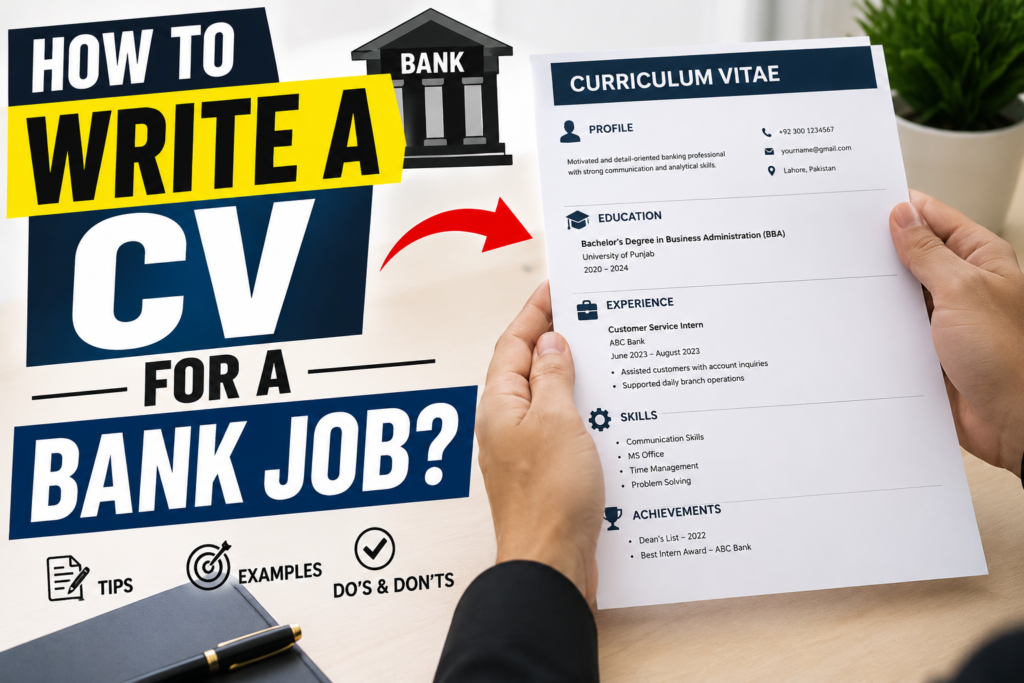
Learn How to Write a CV for a Bank Job?. The banking sector is one of the toughest job markets on Earth. From retail to investment, a corporate role or a call center, your CV is the only marketing tool you have at your disposal. And if there was one key take-away for 2026: one-size-fits-all applications simply doesn’t cut it and gets rejected in a matter of seconds.
A compelling, ATS-compatible and achievement-filled resume is what separates you from the crowd at institutions like FNB, ZANACO, Danske Bank, and international financial entities.
Bank CV recruiters / recruiters for investment positions usually will take a minimum of between 6 to 10 seconds to review your resume during a job review phase, so ensure yours is not over-written, does not have irrelevant sections and the necessary keywords are clear within minutes.
Choosing the Right CV Format
The Chronological Format
For those established banking professionals, chronological format is the most common and desired. Your work experience would be arranged in reverse chronological order with your most recent experience last. This format provides the recruiter a quick reference of career progression, retention, and responsibilities increase, all are very important criteria in banking.
When to Consider a Functional or Hybrid Format
A functional or skills based CV. It concentrates on skills as opposed to a chronological work history. Useful if you have had large gaps in your work history or if you are changing career paths completely.
In conservative fields such as the banking industry it is better to use the chronological or a hybrid format (where you combine a strong summary of skills with a chronological background).
A chronological format for freshers where your strengths of education and internships have emphasis is more suitable.
| Feature | Chronological Format | Functional/Skills-Based Format |
|---|---|---|
| Best For | Experienced candidates with a solid work history | Career changers or those with employment gaps |
| Emphasis | Career progression and job titles | Transferable skills and core competencies |
| Banking Preference | Highly Preferred (Standard) | Rarely Preferred; Use only if justified |
| Structure | Reverse-chronological work history | Skills summary at the top, brief history below |
Essential Sections of a Banking CV
Header and Personal Information
Your header should be clean and professional. Include:
- Full Name: In a larger, bold font.
- Phone Number: Ensure it is correct and you are reachable.
- Professional Email: Use a standard format like
firstname.lastname@gmail.com. - Location: City and country/state. Do not provide your full street address .
- LinkedIn Profile (Optional but Recommended): A link to a professional, updated LinkedIn profile .
- Professional Title: A clear title like “Credit Analyst” or “Customer Service Advisor” .
Professional Summary
This is a brief, 3-4 line statement that acts as your elevator pitch. It should summarize your experience, key skills, and career goals .
- Example: 5-Year Finance-Industry Professional in Banking & credit analysis. Experience developing and directing credit & investment strategies, analyzing complex financial reports, managing business risks for retail & wholesale transactions. Sales-record of growing client assets by 35%, with results focused on growing banking operations.
Also Check: FPSC Roll Number Slip Download 2026: For All Candidates
Key Skills Section
List relevant skills in bullet points for easy reading . Prioritize skills mentioned in the job description. This section helps pass ATS scans .
- Hard Skills Financial analysis, credit risk, loan origination, AML, AML, KYC/R, Modeling (Financial, economic, statistical, regulatory), regulatory reporting and compliance digital banking platforms.
- Soft Skills Client relationships management, communication skills, decision skills, negotiation, attention for details.
Work Experience
This section is where you prove your value. Use the PAR (Problem-Action-Result) method to describe your achievements.
- Action Verbs: Start each bullet point with a strong verb like Managed, Increased, Reduced, Developed, Led, Analyzed, Implemented.
- Quantify Everything: Numbers speak louder than words in banking .
- Instead of: “Responsible for loan portfolio.”
- Write: “Managed a $50M loan portfolio, improving recovery rates by 25% .”
- Instead of: “Handled customer complaints.”
- Write: “Resolved 50+ customer queries daily, maintaining a 98% customer satisfaction rating .”
- Deal Experience: If applying to investment banking, highlight specific deals, models, or projects you worked on.
| Common (Weak) Mistake | Effective (Strong) Wording |
|---|---|
| “Responsible for answering calls.” | “Responded to 60+ inbound customer calls daily, achieving 100% service level targets.” |
| “I worked on annual reports.” | “Authored and analyzed quarterly financial reports, ensuring 100% compliance with IFRS standards.” |
| “Assisted with sales.” | “Increased new client acquisitions by 25% within 6 months through proactive cross-selling.” |
| “Did credit checks.” | “Conducted comprehensive KYC and due diligence checks, reducing compliance risk by 15%.” |
Education and Certifications
- Education: List your most recent education first. Include the institution name, degree, and graduation year . For fresh graduates, placing education above work experience is acceptable .
- Certifications: Banks value professional certifications . Include globally recognized credentials like:
- CFA (Chartered Financial Analyst)
- ACCA (Association of Chartered Certified Accountants)
- CPA (Certified Public Accountant)
- FAIS/FSCA (for South African market)
- AML/CFT certifications
Additional Sections
- Awards & Recognition: Any performance awards you’ve received.
- Volunteer Work: Especially if related to financial literacy or community projects.
- Languages: Helpful for international banks.
Key Strategies for Write a CV
Tailor for Each Job Application
This is arguably the single most important rule. Your CV should reflect that of a Branch Manager job rather than a Risk Analyst CV. If you do not adapt your CV per role and per bank, then do not expect anything. You should tailor use words mentioned within your skills, experience as well as your expertise sections that correlate within the advertisement as these words are searched by ATS Applicant Tracking Systems.
The 1-2 Page Rule
For most bankers (unless you’re the C-suite), your CV should be 1-2 pages in length. In investment banking it’s normally just a page. Pack in your experience and information efficiently. Use bullet points and clear, succinct sentences to save on room.
ATS Optimization
- Keywords: Use keywords from the job description in your summary, skills, and experience sections .
- Formatting: Use standard fonts like Arial, Calibri, or Times New Roman. Avoid tables, columns, images, or graphics as ATS software often struggles to read them.
- File Format: Save your CV as a .docx or .pdf. Some banks prefer PDF for formatting consistency, but follow the specific application instructions.
Proofread and Check Formatting
Typos and badly formatted CV are killer in a banking role 9The right CV. Inconsencies in your fonts. Spacings, use of bold.
Punctuation will tell the reader that you haven’t got the right kind of attention to detail required for a banker.
You do really need someone else to check for errors – a peer, your tutor, a mentor etc.
Global and Industry-Specific Considerations
- Typos and badly formatted CV are killer for a banking role 9The CV. Spelling mistakes. Wrong fonts.
- The right space.
- Bold typeface in bits
- Poor use of punctuation will make the employer realise that he/she requires more of you attention than would be required by a bank clerk. You may find out what are your typing errors just when another eye on one’s work points out all your weaknesses. Ask a peer, your tutor or some good mentor!
Frequently Asked Questions (FAQs)
What’s the ideal CV format for a banking job?
A chronological format is generally the best for most banking positions. This format highlights the natural career progression, continuity, and increased responsibility that is highly valued in the finance sector.
How long should a banking CV be?
For non-managerial positions keep your CV to between 1 to 2 pages. A strict one-page CV is compulsory for certain areas of finance (e.g., investment banking) due to a highly competitive environment.
What is an Applicant tracking system (ATS) And why is it relevant for Banks?
ATS are used in Banks to short-list CVs by screening those where resume includes particular keyword present in the job profile, It eliminates many applications automatically even without a glance from the human at the hiring end especially in a Bank when there may be many applications per role – an CV including the desired keyword will help you clear this first hurdle, stick with standard fonts, avoid tables and pictures if unsure it may play up ATS technology.
How to get my CV to stand out in a way that is not an exaggeration?
Try to provide tangible evidence to your successes – ‘quantify it’, if you increased sales by 20% or “managed a $50M portfolio” say so as this gives clear indication to your achievements.
Should I put a photo on my banking CV?
No; as a general rule in most countries, including the US, UK and Europe, it is not professional and not accepted. If you are unsure always go with the more professionally appropriate version (the photograph).
Conclusion
Formatting a Great Banking CV. With all that being said, if one were going to consider developing a compelling, outstanding CV for a banking job in 2026 one needs, first, adopt the ideal formatting. You may just realize getting an interview is somewhat simpler once you decide on adopting suitable content the required application, presenting a number of quantifiable outcomes as you may see in this guide that’s completely compliant with some of the ATS standards. The only matter is one doesn’t need to simply have CV work experience and skills in many cases it takes a document that clearly will give you a edge to win the buyer over in seconds.
