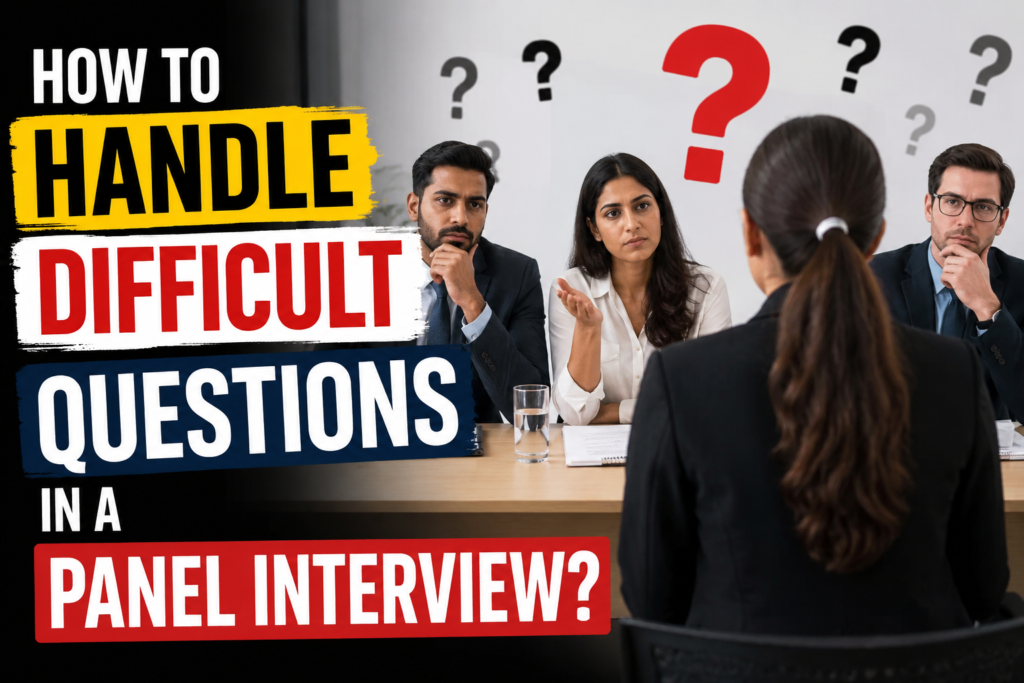
Learn How to Handle Difficult Questions in a Panel Interview?. In all reality, most all of us are at least a little nervous prior to the typical one on one interview. Try to put that feeling out there on five. For the job applicant who is going to encounter the interview panel, which entails sitting at the same time before the hiring team can be downright interrogating, rather than conversational. All those sets of eyes on you at the same time can begin to add pressure to be cool, present information concisely and present yourself as competent overall.
The good news is that a panel interview indicates you are one of the front-runners; after all, a company isn’t going to use up the time of multiple people on your behalf unless you’re a serious candidate. But this interview structure will assess more than just your skills and experience. It will determine how you handle pressure, how effectively you can communicate, and your overall adaptability.
Standard interview questions may be easy to prepare for, but it is the “curveballs”-the surprising, the difficult, even stressful–that separate a “yes” from a “no thanks” reply.
Understanding the Psychology of a Panel Interview
Before We Get to the “How-To” You Need to Know the Rules. This is NOT designed to trick you; it’s designed to see if you can survive a corporate board room. The Power Dynamic You are the Minority.
Sitting on one side of a long conference table with everyone else on the other is meant to be a power display.
It shows how you handle pressure, because in business you’ll often find yourself in high-pressure situations. Different Panelist have Different Agendas: You are going to meet more people than just your potential boss.
Generally you’ll find: The Manager You’d work for
- The Human Resources Representative (cultural fit/company policies)
- A colleague/team member (technical fit)
- A senior executive (long term potential)
Each panelist is trying to get you to say “uh oh” and they ask different things. A question from your potential manager is going to be different than a question from your colleague and so on. If you can identify who is who and tailor your answer.
You Win the Consensus Game You don’t need to knock everyone out of the park. You just can’t trip too much and turn anyone “red” against you. Everyone in the room wants to agree you’re good, you just need to keep your cool and not do anything that’ll make it difficult.
How to Handle Difficult Questions in a Panel Interview?
When someone asks you an answerable but uncomfortable question, it causes a “fight or flight” response. Your heart may start to pound, you may feel that you are losing control. You must use structure.
The P.A.C.E. Method
We created the P.A.C.E. Method to help you to maintain control of the interview:
- P – Pause and Breathe: Don’t launch into the answer. Taking 3 seconds to think makes you appear confident, not flustered and gives you the chance to think clearly.
- A – Acknowledge the Question: Show the questioner you respect them: “That is a very thought provoking question”. Or “I appreciate you bringing that up.” Buy yourself time and make them feel valued.
- C – Clarify: If there is ambiguity in the question, ask the questioner: “By leadership style, would that refer to my dealings with senior people, or my reports?”.
- E – Execute: This is where you deliver your structured answer using one of the techniques outlined below.
Top 5 “Difficult” Question Categories and How to Answer Them
The interviews panel are often happy to ask tough and testing questions to make you slip up – here’s how to answer them:
The “Tell Me About a Time You Failed” Question
This is the boss of hard interview questions. Its aim is to see how you take on feedback, if you have an adequate degree of humility and whether you learn from mistakes.
The “Failure” Framework
You must tell a story where you failed, but you survived.
- The Context: Set the scene. “We were launching a new software update
- “The Error: “I underestimated the time needed for user testing.”
- The Consequence: “The launch was delayed by two weeks.”
- The Action: “I immediately implemented a new quality assurance protocol to ensure this didn’t happen again.
- The Lesson: “I learned that thorough planning is better than speed.”
Crucial Tip: Never choose a failure that resulted in a massive financial loss or the collapse of a team. Choose a professional misstep that highlights a soft skill.
The Hypothetical “What Would You Do If…?” Scenario
Panel interviews love situational questions. The panel is not interested in the “right” answer; they are interested in your thought process.
The Situational Framework
Walk Them Through It “If I were in that position, I’d look at”.
Identify Stakeholders “I’d involve the finance team, as well as the client.”
State Logic “Using the data we had at the time, I would focus on doing X before Y.”
Don’t be afraid to not know “I am not completely sure about the exact technical implementation of that, but I know I would reach out to Resource. A or seek out the guidance of my colleague B to find out how. This is how I approach issues.”
The “Salary Expectations” Ambush
Often asked by the HR representative, this question can be tricky. If you ask for too much, you’re out. Too little, and you’re undervaluing yourself.
Handling Money with Class
- Deflect First: “I’m more focused on the role and the career opportunities associated. But I am sure we can find something we can both be comfortable with.”
- The Research: “I have conducted some research in the market and in the industry, and the range seems to be between X and Y”
- The Value: “With my 10 years of experience in this specific field, I’m seeking compensation in line with the value I can offer, and I feel that would be towards the top end of that scale.”
The “Why Did You Leave Your Last Job?” Cross-Examination
This could be a very tricky question for you, especially if you were terminated or if you left your position in an undesirable manner. The interview panel is trying to identify any potential signs of arrogance or avoidance of personal responsibility.
The Honest Spin
- If Laid Off: “The company went through a restructuring, and unfortunately my position was made redundant. I’m really proud of what I accomplished there, like [Insert Achievement], and I’m eager to do more.”
- If Resigned: “ I think I’ve hit a ceiling in my current role. I’m seeking a more stimulating challenge where I can really stretch my skills in [Specific Skill].”
- If Fired (Handle With Care): “ There was a performance gap in terms of the requirements of the role. I’ve learned from that experience, and in the time since I’ve been actively developing my skills in [Skill You Improved] to make sure I’d be a great fit for this role.”
The “Where Do You See Yourself in 5 Years?” Trap
It depends if you’re testing their ambitions and drive, or realism. If you say “Your job”, they’ll think you’re threatening them. If you say “I don’t know”, they’ll think you’re not ambitious.
The “Mastery” Approach
- Commitment: “I want to be recognized as the go-to expert in [Specific Domain).”
- Growth: “I want to be in the loop with the systems and start mentoring newer team members.”
- The Company: “I hope I have grown with the company.”
Also Check: Branch Manager Jobs 2026: 200k Salary | Last Date
Mastering Non-Verbal Communication During the Grilling
For an interview, what you say isn’t always as important as how you say it in an interview, as you have more people to scrutinise your body language, not one.
Eye Contact
- The Triangle: You shouldn’t make prolonged eye contact with one panelist. When that panelist is asking you a question, you should look to that panelist. When you are answering their question, you should move your eye contact around the entire group and bring your eye contact back to the panelist.
- The Power Gaze: You should not look down at the table or at your notes. Doing this would be seen as submission and weak.
Posture and Hand Gestures
- Body Language (Body Confidence): Sit up tall. Move forward and into the space you are in to convey active interest. Don’t slouch.
- Body Language (Open Hands): Employ open-palm gesturing whenever you describe a concept; it suggests you are being truthful and open.
- Keep your hands where people can see them: hiding your hands behind your back and crossing your arms suggest you have something to defend.
The “I Don’t Know” Strategy
We all have limits. Being asked a question about a technology you don’t know or a process you’ve never seen is a reality of panel interviews.
The “Don’t B.S.” Rule
Never, ever try to bluff your way through a technical question in a panel interview. There is likely an expert in the room who knows you are making it up. You will lose all credibility.
How to Say “I Don’t Know” Without Losing the Job
- The Transition: “That is an interesting one.”
- The Honesty: “I actually haven’t used that software yet.”
- The “Bridge”: “I have, however, used [Similar Software A] and [Similar Software B] to do [X results] and am a very quick learner when it comes to new programs, so I know I’ll be proficient with it in no time!”
This demonstrates honesty, a resourceful attitude, and relevant transferable skills.
Closing the Interview Strongly
The last question asked in a panel interview is invariably “Do you have any questions for us?” This is your opportunity to re-establish some control. The worst question (for instance “How many vacation days do I get?”)
is a career-ender.
The best questions focus on a much longer term.
Questions that Impress
- The manager should ask: “What will success for the individual filling this position look like in the first 90 days?”
- The HR rep: “How do you characterize the culture of the team?”
- The exec: “What are the greatest challenges in this department or company in the next quarter?”
- The peer: “What’s the favorite thing about working here?”
FAQs
What to do if I entirely freeze out on an answer?
Answer: Take a pause. “Just give me a moment to collect my thoughts.” And then reframe the question out loud: “So you’re asking about my approach to conflict resolution.”
How to handle a panelist that is hostile or trying to trip you up?
Answer: This is generally a stress test. Do not mirror hostility. Be calm and professional. Kill ’em with kindness.Directly acknowledge the panelist. “Thanks for asking me that.”.They want to know how you handle adversity and keep your cool, not necessarily that you can “win” a conversation.
Should I address the panelist form or informally?
Answer: When in doubt, address panelist(s) form. Address panelists by Mr. /Ms. Unless they explicitly instruct you otherwise to use first names. If you have absolutely no idea of names, use “Sir” or “Ma’am” but try your best to note the panelists’ names. Make it a point to use their names once you’ve learned them.
Is it all right to take notes during the panel?
Answer: Absolutely!. It is great to bring a professional pad and pen and take notes.
Jot down panelists’ names. Also if they have given a multipart question, take a moment to quickly write down the parts.
What if a panelist cuts me off or talks over me?
Answer: Just stop and let them speak. Occasionally, a panelists will jump in as an idea pops into their mind. Once they finish, Smile and say something such as “I am so glad you mentioned that,” and then continue where you left off, or simply resume your response.
Conclusion
Your approach to the tough question in your panel interview isn’t just about having a solid answer; it’s about having the right presence. Panel interviewers want to see if you can perform under pressure, whether you can be a pillar of composure during a fire. Here’s a quick summary of how to implement the P.A.C.E.
Method: Pause, Acknowledge, Clarify, Execute.
Breathe deeply, format your narratives, and never be ashamed to say you “don’t know” politely. Show up prepared, show up professionally, and remember that you are assessing them too! You’ve got the goods. You’ve got the experience.
Now you’ve got the blueprint for how to present them during those high-stakes situations.
Nail this interview.